

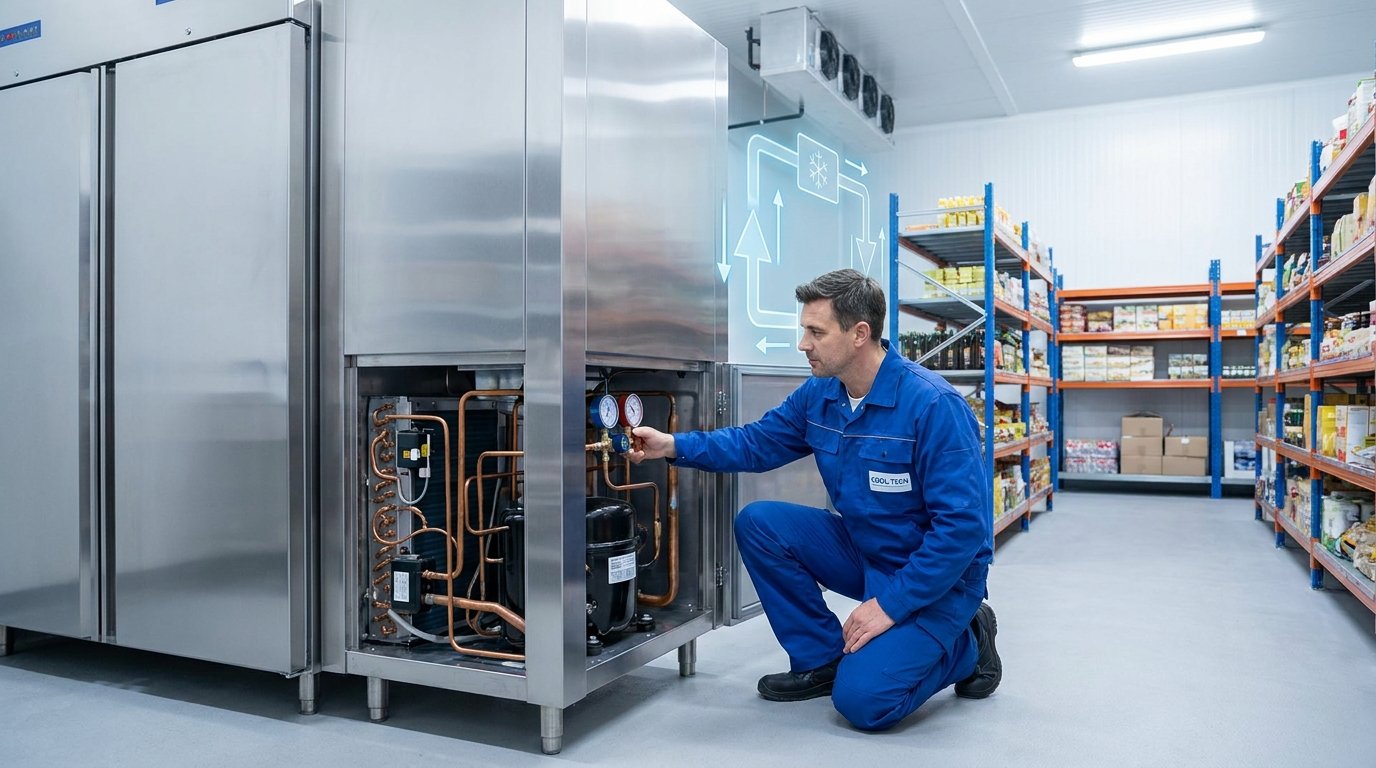
19 Jul How Does Commercial Refrigeration Work?
What Is Commercial Refrigeration?
Commercial refrigeration refers to large-scale cooling systems used by businesses to preserve perishable goods, maintain safe storage temperatures, and ensure product quality. Unlike the domestic refrigerator found in a home kitchen, commercial refrigeration systems are purpose-built to handle the demands of high-volume environments such as supermarkets, restaurants, food manufacturers, pharmaceutical warehouses, and cold storage facilities.
At its core, commercial refrigeration is a scientific process that transfers heat from one place to another, maintaining controlled internal temperatures regardless of external conditions. Understanding how this process works helps business owners make more informed decisions about their equipment, maintenance schedules, and energy consumption.
At Jaylee Refrigeration, we have been designing, installing, and maintaining commercial refrigeration systems across the South of England for many years. In this guide, we walk you through exactly how commercial refrigeration works, what equipment is involved, and how to keep your system performing at its best.
The Science Behind It: Thermodynamics and the Cooling Process
To understand how commercial refrigeration works, it helps to understand the basic principles of thermodynamics. Refrigeration does not actually "create cold." Instead, it removes heat from an enclosed space and transfers it elsewhere. This is achieved through a continuous cycle involving a refrigerant, which is a chemical compound capable of rapidly changing between liquid and gas states.
The refrigeration cycle relies on two key thermodynamic principles:
- Heat naturally moves from warmer areas to cooler ones. Refrigeration systems exploit this behaviour by using a refrigerant to absorb and carry heat away from the storage space.
- Liquids absorb heat when they evaporate and release heat when they condense. By controlling when and where the refrigerant changes state, the system determines precisely where heat is absorbed and where it is expelled.
This process is known as the vapour compression refrigeration cycle, and it forms the basis of virtually all modern commercial refrigeration systems. You can read more about refrigeration cycles and the underlying thermodynamics here.
How Does the Commercial Refrigeration Cycle Work?
The commercial refrigeration cycle consists of four key stages, each performed by a dedicated component within the system.
1. Compression
The cycle begins at the compressor. Refrigerant enters the compressor as a low-pressure, low-temperature gas. The compressor raises both the pressure and temperature of the gas significantly, transforming it into a high-pressure, high-temperature vapour ready to move to the next stage.
The compressor is often described as the heart of any refrigeration system. Without it, the refrigerant would not circulate and no cooling would take place.
2. Condensation
From the compressor, the hot, high-pressure gas travels to the condenser. In most commercial systems, the condenser is located externally or in a well-ventilated area. Here, heat from the refrigerant is released into the surrounding air. As the refrigerant loses this heat, it cools and changes state from a gas into a liquid.
This is the stage at which heat is expelled from the system into the external environment.
3. Expansion
The liquid refrigerant then passes through an expansion valve, which causes a rapid drop in pressure. This sudden reduction causes the refrigerant to cool dramatically, arriving at the next stage as a cold, low-pressure liquid.
4. Evaporation
The cold refrigerant enters the evaporator, which is situated inside the refrigerated space. As the refrigerant flows through the evaporator coils, it absorbs heat from the air surrounding it. This absorbed heat causes the refrigerant to evaporate back into a gas, and the interior of the cabinet or cold room becomes noticeably cooler.
The refrigerant, now a low-pressure gas once more, returns to the compressor and the cycle begins again. This continuous loop ensures a consistent internal temperature is maintained around the clock.
For a closer look at the components involved in this process, this guide to the four main refrigeration cycle components provides a useful overview.
What Role Does the Compressor Play?
The compressor is the single most important component in any commercial refrigeration system. It drives the entire refrigeration cycle by pressurising the refrigerant and forcing it through the system.
In commercial settings, compressors are typically much larger and more powerful than their domestic counterparts. They must operate continuously and withstand the demands of high-volume environments where doors are frequently opened and closed, and where large quantities of product need to be cooled at once.
When a compressor fails or underperforms, the consequences are immediate: temperatures rise, product quality is compromised, and food safety may be at risk. This is why regular inspection of compressor performance is a fundamental part of any commercial refrigeration maintenance programme.
Types of Commercial Refrigeration Equipment
Commercial refrigeration is not a one-size-fits-all solution. Businesses have varying temperature requirements, spatial constraints, and product types, all of which influence the kind of system best suited to them. Here are the most common types of commercial refrigeration equipment in use today.
Refrigerated Display Cases and Multidecks
These are open or glass-fronted cabinets commonly found in supermarkets, delicatessens, and food retail outlets. They keep products visible and accessible to customers while maintaining safe storage temperatures.
For businesses looking to reduce running costs, glass door display multidecks offer a significant advantage. Glass door versions can deliver energy savings of between 40% and 50% compared to open-fronted alternatives, making them an excellent long-term investment for any food retailer.
Cold Rooms and Freezer Rooms
Cold rooms and freezer stores are walk-in refrigerated spaces used to store large quantities of produce, dairy products, meat, and frozen goods. They are common in the hospitality sector, food manufacturing, and food distribution.
At Jaylee Refrigeration, we specialise in the design and installation of cold rooms and freezer rooms tailored to each client's exact specifications. We carry out site surveys, design the room layouts, and specify all the necessary refrigeration equipment to ensure the finished installation meets your operational requirements fully.
Bespoke Refrigerated Displays
Not every business can source off-the-shelf refrigeration equipment that perfectly suits its space or brand. For those with specific requirements, bespoke refrigerated displays provide a made-to-measure solution.
Our team designs and installs specialist bespoke displays tailored to meet each customer's individual requirements. If you cannot find what you are looking for on the market, we can make it for you.
Bottle Coolers and Under-Counter Refrigeration
Popular in bars, cafes, and small food outlets, these compact units are designed to keep beverages and small volumes of product chilled. They are available in numerous configurations to fit within existing counter or shelving arrangements.
Remote and Centralised Refrigeration Systems
Larger commercial operations often make use of remote or centralised refrigeration systems, where the compressor and condenser are located away from the display cases or cold rooms. This approach improves energy efficiency, reduces in-store noise levels, and simplifies servicing. Explore our full range of commercial refrigeration services to find out more.
Which Industries Rely on Commercial Refrigeration?
Commercial refrigeration is a critical operational requirement across many sectors, including:
- Food retail and supermarkets – for fresh produce, dairy, meat, and frozen goods
- Hospitality and catering – restaurants, hotels, and event catering companies all require reliable cold storage
- Food manufacturing and processing – raw materials and finished products must be stored at precise temperatures throughout production
- Pharmaceuticals and healthcare – medicines, vaccines, and laboratory samples often require strict temperature-controlled environments
- Logistics and cold chain distribution – refrigerated warehousing and cold stores are essential for maintaining product integrity during storage and transit
Each of these industries has specific temperature requirements, compliance obligations, and capacity needs, which is why professional design and installation are so important.
5 Signs Your Commercial Refrigeration System Needs Attention
Even the most reliable commercial refrigeration systems can develop problems over time. Catching issues early can prevent costly breakdowns and significant product loss. Here are five common warning signs to watch for:
- Inconsistent or rising temperatures – If your system is struggling to maintain the set temperature, the compressor, refrigerant level, or evaporator may need attention.
- Excessive frost or ice build-up – Ice forming on coils or inside the unit can indicate a problem with the defrost cycle, door seals, or refrigerant charge.
- Unusual noises – Rattling, grinding, or banging sounds from the compressor or fan motor are often early signs of mechanical failure.
- Water pooling or leaks – Condensate drain blockages, faulty door gaskets, or refrigerant leaks can all cause moisture issues around or inside the unit.
- Higher than usual energy bills – A sudden increase in electricity usage can indicate the system is working harder than it should to maintain temperature, often pointing to an underlying component issue.
If you notice any of these signs, it is important to seek professional advice promptly. Our maintenance and repair service operates 365 days per year, ensuring support is always available when you need it most.
Commercial Refrigeration Maintenance Tips
Routine maintenance is the single most effective way to extend the life of your refrigeration equipment, reduce energy consumption, and avoid unexpected breakdowns. Here are some key maintenance practices every business should follow:
- Clean condenser coils regularly – Dust and debris on condenser coils reduce heat transfer efficiency and force the system to work harder than necessary.
- Inspect and replace door gaskets – Worn or damaged door seals allow warm air to enter the refrigerated space, raising internal temperatures and increasing energy use.
- Check refrigerant levels – Low refrigerant is a common cause of poor cooling performance and can indicate a leak that must be addressed by a qualified engineer.
- Monitor temperatures daily – Keeping a log of internal temperatures helps identify gradual changes that might otherwise go unnoticed until they become serious.
- Keep air vents and grilles clear – Obstructed airflow around condensers and evaporators reduces system efficiency significantly.
- Schedule professional servicing – Regular servicing by a qualified engineer helps identify wear and potential failures before they develop into costly problems.
At Jaylee Refrigeration, we offer a first-class maintenance service available every day of the year. Our experienced engineers provide prompt, reliable support across the South of England, and we are proud to have built long-standing relationships with many of our clients as a result.
One customer describes their experience:
"We have found Jaylee very attentive to our refrigeration requirements for sales and service. All the team give an excellent service, always helpful, friendly and reliable. The important thing is they respond to you promptly whenever you need them. That is what I call customer service. Well done!! Jaylee!!"
Energy Efficiency and F-Gas Compliance
Energy efficiency is an increasingly important consideration for businesses operating commercial refrigeration equipment. More efficient equipment reduces running costs and helps businesses meet their environmental responsibilities, both of which are significant priorities in today's trading environment.
In the United Kingdom, commercial refrigeration is subject to F-Gas (fluorinated greenhouse gas) regulations, which are designed to reduce the environmental impact of refrigerants used in cooling systems. Businesses operating refrigeration equipment containing F-gases are required to ensure regular leak checks are carried out and that any maintenance or servicing is performed by qualified and certified engineers.
The UK Government provides up-to-date guidance on F-Gas bans and restrictions on new products and equipment, and it is important for all businesses with refrigeration equipment to remain aware of the latest requirements and phase-down timelines.
When it comes to newer, more energy-efficient equipment, the operational benefits can be considerable. Our low-energy glass door multideck displays offer energy savings of between 40% and 50% compared to traditional open-fronted units. Tax relief is also available on the total price of qualifying installations, and we offer flexible payment terms to help businesses spread the cost of upgrading their equipment without placing undue pressure on cash flow.
Should You Repair or Replace Your Commercial Refrigeration Equipment?
When a commercial refrigeration system develops a significant fault, businesses are often faced with the question of whether to repair existing equipment or invest in a replacement. The right answer depends on several factors.
Repair is likely to be the better option if:
- The system is relatively new and the fault is isolated to a single component
- The cost of repair is significantly lower than the cost of replacement
- The unit is otherwise in good condition and continues to meet your operational needs
- Replacement parts are readily available and the system uses compliant, current refrigerants
Replacement may be more appropriate if:
- The system is ageing and has required increasingly frequent repairs
- It relies on refrigerants being phased out under F-Gas regulations
- A newer system would deliver meaningful energy savings that justify the capital outlay
- The equipment no longer meets the capacity or temperature demands of your operation
Our team is always happy to provide honest, straightforward advice on whether repair or replacement represents the better investment. We listen to our customers' requirements and offer the best possible solutions at competitive prices with flexible payment terms, ensuring every business gets the right outcome for its specific circumstances.
How Jaylee Refrigeration Can Help
At Jaylee Refrigeration, we are a family-run business with a long-standing reputation for technical excellence, reliability, and outstanding customer care across the South of England. We provide a comprehensive range of services, from bespoke refrigeration design and installation to ongoing maintenance and emergency repair support.
Our approach is straightforward: we listen carefully to what each customer needs and deliver solutions that genuinely work for them. Whether that means designing a cold room for a food manufacturer, installing energy-efficient display equipment for a supermarket, or responding rapidly to an out-of-hours breakdown, we bring the same level of expertise and commitment to every project.
Our clients reflect this in their own words:
"Jaylee installed a freezer store for Wiltshire Farm Foods in Trowbridge. Throughout all phases their performance was excellent. They responded well to our changes during the design process. The project achieved all our project KPIs of cost, programme and technical quality. Overall this is an installation that represents true 'value for money' and Jaylee were a pleasure to work with."
"Reliable, trustworthy family run business who always give good service. They have reliable engineers which is why I have used Jaylee for over 10 years!"
If you would like to find out how we can support your business with commercial refrigeration, get in touch today for a free quotation. You can also meet our team to learn more about the people who make it all happen.